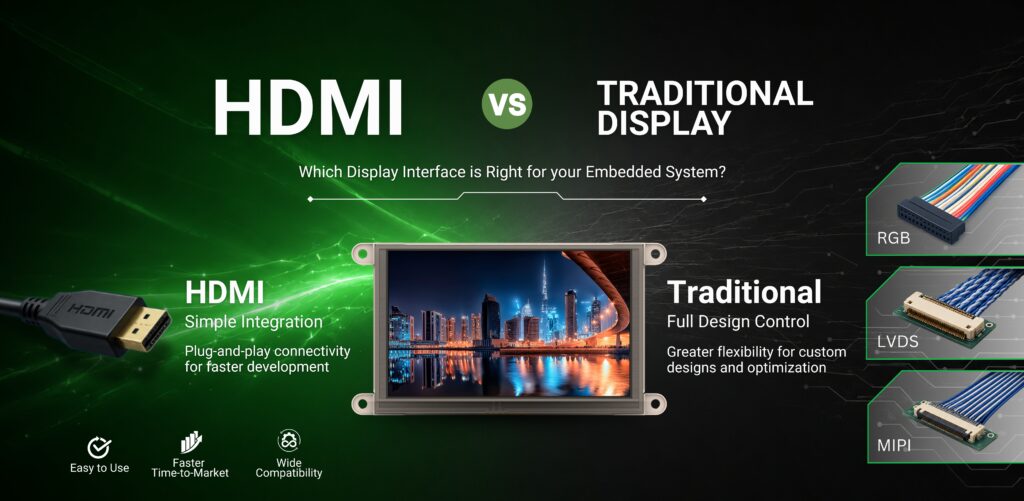
HDMI vs Traditional Display Interfaces: Which One Should You Choose?
HDMI vs RGB, LVDS, and MIPI. Learn the key differences, advantages, and how to choose the right display interface for your embedded system.
Choosing the Right Display Interface Matters
When designing an embedded system, selecting the right display interface is not just a technical decision. It directly impacts development time, system complexity, cost, and long-term scalability.
Common interfaces such as RGB, LVDS, and MIPI each have their place. However, HDMI is increasingly becoming a preferred option for many modern applications.
So how do you decide which one is right for your project?
Understanding Traditional Interfaces
RGB (Parallel Interface)
RGB is widely used in embedded systems and offers direct control over the display. However, it comes with:
- High pin count
- Strict timing requirements
- Increased design complexity
It is suitable for tightly controlled embedded environments but often requires experienced hardware design.
LVDS (Low-Voltage Differential Signalling)
LVDS is commonly used for higher-resolution displays and offers:
- Better noise immunity
- Longer cable support
- Stable signal transmission
However, it still requires careful layout design and dedicated display controllers.
MIPI (Mobile Industry Processor Interface)
MIPI is compact and efficient, often used in mobile and high-performance devices. It provides:
- High-speed data transfer
- Reduced pin count
- Efficient power usage
But integration can be complex and requires specific processor support.
Where HDMI Stands Out
HDMI simplifies display integration by offering a standardised, widely supported interface.
Key advantages include:
- Plug-and-play connectivity
- Minimal hardware design effort
- Broad compatibility with processors and SBCs
- Reduced development time
Unlike traditional interfaces, HDMI eliminates the need for deep display timing design and signal tuning.
When HDMI Is the Better Choice
HDMI is particularly suitable when:
- You want to accelerate development timelines
- Your system already supports HDMI output
- You are working with SBCs or embedded PCs
- You need a quick and reliable display solution
- You want to reduce engineering complexity
This makes it ideal for prototyping, evaluation, and even production in many industrial and commercial applications.
When Traditional Interfaces Still Make Sense
Despite the advantages of HDMI, traditional interfaces are still relevant when:
- You require full control over the display pipeline
- Power consumption must be tightly optimised
- Space constraints demand minimal connectors
- Your system architecture is already built around RGB, LVDS, or MIPI
The right choice ultimately depends on your application requirements.
How 4D LCD Supports Both Approaches
At 4D LCD, we understand that there is no one-size-fits-all solution.
We support both:
- HDMI display solutions for simplified integration
- Traditional interface LCDs (RGB, LVDS, MIPI) for custom and performance-driven designs
Our role is to help you choose the most practical and efficient approach based on your system architecture, timeline, and technical requirements.
Making the Right Decision
Choosing between HDMI and traditional interfaces is about balancing:
- Complexity vs flexibility
- Speed vs control
- Standardisation vs customisation
If your priority is speed, simplicity, and compatibility, HDMI is often the clear choice.
If your priority is full control and optimisation, traditional interfaces may still be the better fit.
Recommended HDMI TFT LCD Products
If you’re looking for a display that offers simple integration and reliable performance, explore these HDMI TFT LCD products:
- 5.0″ HDMI TFT LCD Display – Ideal for embedded systems, SBCs, and compact multimedia applications.
- 7.0″ HDMI TFT LCD Display – A popular choice for industrial HMIs, control panels, and development platforms.
- 10.1″ HDMI TFT LCD Display – Perfect for interactive kiosks, medical devices, and smart home interfaces.
- 15.6″ HDMI TFT LCD Display – Designed for digital signage, industrial workstations, and commercial display applications.
You can also browse our complete HDMI Display Range to explore additional display sizes and interface options.
Talk to Our Team
If you are unsure which interface is right for your project, our technical team can guide you through the decision-making process.
Contact us at info@4dlcd.com or explore our HDMI display range:
https://4dlcd.com/product-category/hdmi-displays/

4D LCD provides advanced TFT LCD display solutions for industrial, medical, automation, instrumentation, embedded and other electronic applications, with standard and customised display options for customers worldwide.