
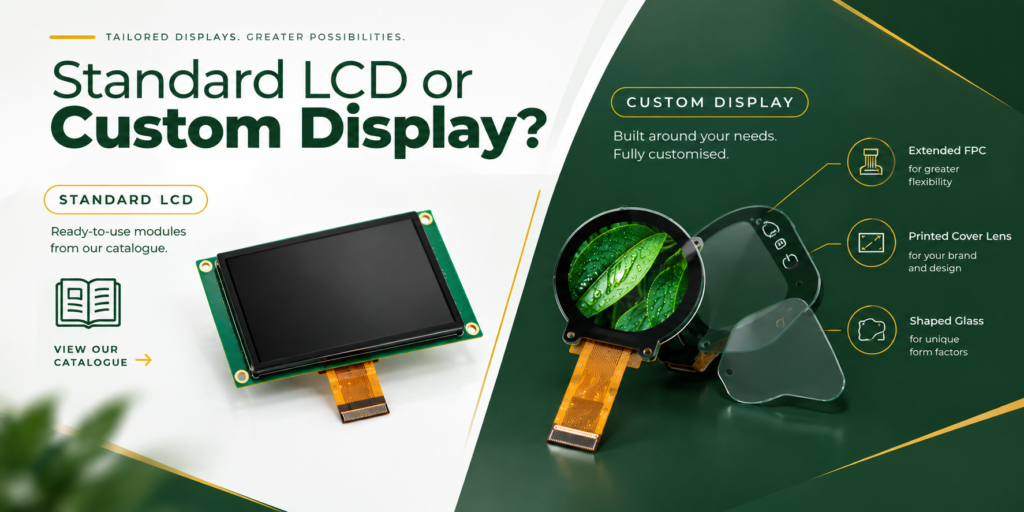
Standard LCD module vs Custom LCD Display: Which One Should You Choose First?
Custom does not automatically mean better, and standard does not automatically mean limiting. The best choice is the option that meets the technical requirements with acceptable risk, cost and lead time. Many OEM projects should begin by checking standard modules and then customise only the parts that genuinely need to change.
When a standard LCD is the sensible choice
A standard module is usually best when its dimensions, interface, brightness, touch option and temperature range already fit the product. It can reduce development cost, simplify sampling and shorten the path to production.
When standard modules start creating compromises
Problems arise when the enclosure must be redesigned around the screen, the FPC exits in the wrong direction, the cover lens does not match the industrial design or the brightness is unsuitable. Repeated compromises may cost more than planned customisation.
What can normally be customised
Depending on the project, changes may include FPC length and pinout, connector, backlight brightness, touch panel, cover lens, decorative printing, surface treatment, optical bonding and mechanical dimensions. Full custom glass is a larger project than modifying a standard platform.
Consider volume, cost and schedule
Customisation generally involves engineering work, sample approval, tooling or NRE and a project MOQ. Expected annual quantity and product lifetime help determine whether the investment is commercially sensible.
Use a staged selection process
Start with a requirement checklist. Review standard products. Identify the exact gaps. Ask the supplier to propose the smallest level of customisation that solves those gaps. This controls risk and avoids unnecessary development.
Make the decision with production in mind
The chosen display must remain practical after the first prototype. Confirm repeatability, test expectations, change control and long-term supply before the design is locked.
How 4D LCD Can Help
4D LCD supports customers from initial product selection and sample evaluation through customisation and production planning. Share the application, target size, interface, touch, brightness, environmental and volume requirements so the team can review suitable standard or custom display options.
Frequently Asked Questions
Is custom LCD development always expensive?
The cost depends on the level of change. Modifying a cover lens or FPC is different from creating custom LCD glass.
Should a project check standard displays first?
Usually yes. A standard platform can reduce cost and development time.
What is NRE?
Non-recurring engineering is a one-time charge for design, tooling or development work.
What quantity makes customisation worthwhile?
There is no single number. It depends on complexity, lifecycle, project value and the cost of using an unsuitable standard module.
Start by reviewing our standard TFT LCD modules to see whether an existing platform fits the project.
Where changes are required, our custom LCD display solutions can support mechanical, optical and interface requirements.
For systems that already provide HDMI output, HDMI display modules may offer a faster integration path.

4D LCD is a display solutions provider specialising in TFT LCD modules for industrial, medical, automation, instrumentation, embedded systems and electronic product applications. With both standard and customised display options, 4D LCD supports customers worldwide with reliable, application-focused display solutions.