
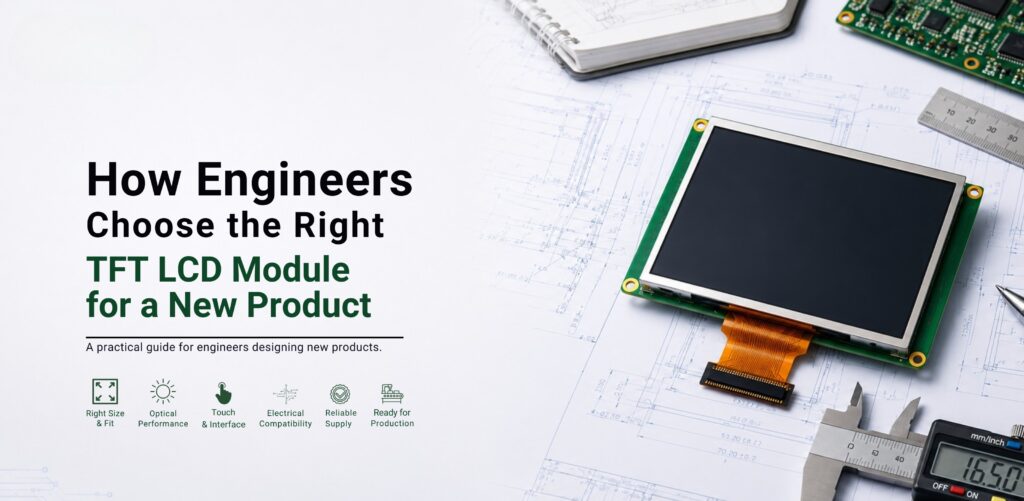
How Engineers Choose the Right TFT LCD Module for a New Product
The right TFT LCD module should support the complete product design rather than forcing the product to work around the display. Engineers normally begin with the application and then narrow the options by reviewing mechanical, optical, electrical and commercial requirements. A disciplined selection process reduces redesign risk and helps a prototype move more smoothly into production.
Begin with the user and operating environment
Consider who will read the display, how far away they will be and whether the product will be used indoors, outdoors, in a vehicle or on a factory floor. This determines the likely size, brightness, touch technology and viewing-angle requirement.
Match the display to the enclosure
Check both the outer dimensions and the active area. Connector position, FPC length, thickness and mounting features can be as important as diagonal size. Select the display before finalising the enclosure whenever possible.
Choose a useful resolution
Higher resolution can improve detail, but it may also increase processing, memory and power requirements. The correct resolution supports the interface design and content without creating unnecessary system complexity.
Review brightness and viewing angle
Brightness must match ambient light. Viewing angle matters when the user may see the screen from different positions. IPS is commonly chosen for wide viewing angles, while other technologies may suit fixed viewing positions or cost-sensitive projects.
Confirm touch and interface compatibility
Decide whether the user needs capacitive touch, resistive touch or physical controls with a non-touch display. Then confirm that the processor can drive the chosen interface and resolution. Two same-size displays should never be assumed to have interchangeable pinouts.
Plan for production, not only the prototype
Ask about MOQ, sample availability, lead time, product lifecycle and change control. A module that works technically but cannot support planned production or lifetime is not the right long-term choice.
How 4D LCD Can Help
4D LCD supports customers from initial product selection and sample evaluation through customisation and production planning. Share the application, target size, interface, touch, brightness, environmental and volume requirements so the team can review suitable standard or custom display options.
Frequently Asked Questions
What is the first step in choosing a TFT LCD?
Define the application, environment, available space and host interface.
Is higher resolution always better?
No. It should match the GUI, processor capability, memory and power budget.
Why does the FPC matter?
Its direction, length and pinout affect PCB layout and whether the module can fit the enclosure.
When should a custom option be considered?
When no standard display satisfies the important mechanical, optical or electrical requirements.
Explore our TFT LCD display range to compare sizes, touch options and interfaces.
If a standard module does not match the enclosure or electronics, a customised display solution may be required.
For help reviewing a shortlist, contact our display team with your project requirements.

4D LCD provides advanced TFT LCD display solutions for industrial, medical, automation, instrumentation, embedded and other electronic applications, with standard and customised display options for customers worldwide.