
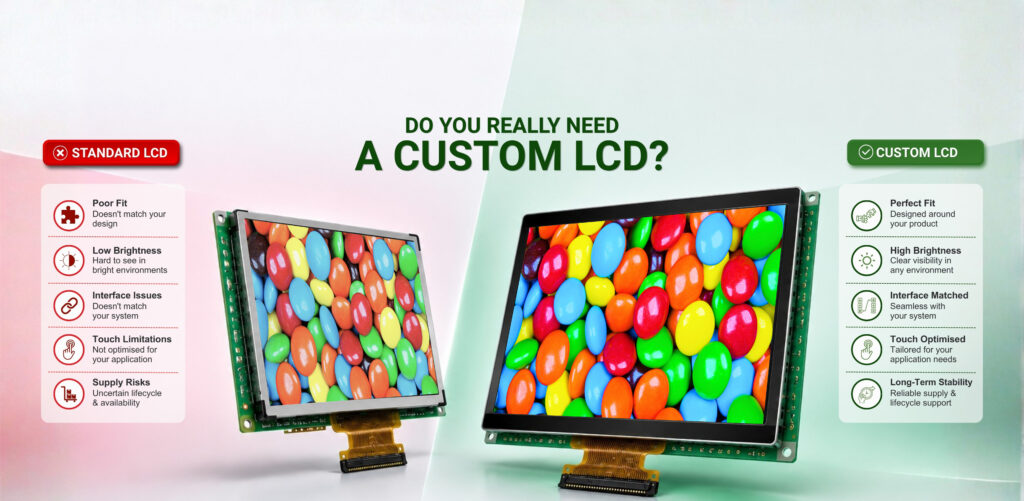
Do You Really Need a Custom LCD? Here’s When It Makes Sense
Do you need a custom LCD? Learn when standard displays fall short and how customisation improves integration, performance, and long-term reliability.
Standard vs Custom: A Common Decision Point
When developing a new product, one of the most common questions is whether to use a standard off-the-shelf display or invest in a custom LCD solution.
At first glance, standard modules seem like the faster and more cost-effective option. And in many cases, they are.
But as projects move from concept to production, limitations often start to appear.
So when does it actually make sense to go custom?
When Standard Displays Work Well
Standard LCD modules are ideal when:
- Your mechanical design can adapt to available display sizes
- Interface requirements match common configurations (RGB, HDMI, etc.)
- Brightness levels meet your environment
- Time-to-market is the top priority
For early-stage development and prototyping, standard displays provide a practical starting point.
Where Standard Displays Fall Short
As products mature, challenges often arise:
- Mechanical mismatch with your enclosure
- Limited brightness for outdoor or high-ambient environments
- Interface constraints with your mainboard
- Touch performance not aligned with your application
- Supply or lifecycle concerns for long-term projects
These are typically the points where customisation becomes necessary.
When Custom LCD Makes Sense
Custom LCD solutions become valuable when your product requires alignment across multiple factors:
1. Mechanical Integration
Your display needs to fit your product, not the other way around.
Customisation can include:
- FPC design and orientation
- Connector type and position
- Cover lens and bezel design
- Touch performance not aligned with your application
- Mounting structure adjustments
2. Optical Performance
Not all environments are equal.
You may require:
- Higher brightness for outdoor readability
- Improved contrast and viewing angles (IPS)
- Optical bonding for clarity and durability
3. Touch Requirements
Different applications require different touch solutions.
Customisation allows:
- Capacitive or resistive touch selection
- Cover lens thickness and treatment
- Glove or wet-touch capability
4. Interface Compatibility
Your display must work seamlessly with your system.
Adjustments can include:
- Interface type (RGB, LVDS, MIPI, HDMI considerations)
- Pin definition alignment
- Signal compatibility with your mainboard
5. Long-Term Supply and Stability
For industrial and commercial products, lifecycle matters.
Custom solutions can support:
- Controlled bill of materials
- Long-term availability
- Reduced risk of redesign due to component changes
5. Long-Term Supply and Stability
For industrial and commercial products, lifecycle matters.
Custom solutions can support:
- Controlled bill of materials
- Long-term availability
- Reduced risk of redesign due to component changes
Custom Doesn’t Mean Starting from Scratch
One common misconception is that custom LCD means building everything from zero.
In reality, most custom solutions are based on proven platforms, with targeted modifications to meet your requirements. This approach balances:
- Development efficiency
- Cost control
- Technical reliability
How 4D LCD Supports Customisation
At 4D LCD, customisation is at the core of what we do.
We work closely with customers to:
- Understand system-level requirements
- Recommend the most practical starting platform
- Implement targeted modifications
- Support from design through to production
Whether you need minor adjustments or a more tailored solution, our goal is to ensure your display integrates seamlessly into your product.
Making the Right Choice
Choosing between standard and custom LCD is not about complexity. It is about fit.
If your project can adapt to a standard module, that is often the fastest path.
If your product demands precision, performance, and long-term stability, customisation becomes a strategic advantage.
Let’s Talk About Your Project
If you are evaluating whether a custom LCD is the right direction, our team can help assess your requirements and recommend the most efficient approach.
- 4.3″ TFT LCD Display – Ideal for compact industrial equipment, medical devices, and control panels.
- 5.0″ TFT LCD Display – A versatile option for embedded systems, HMI applications, and smart devices.
- 7.0″ TFT LCD Display – One of the most popular display sizes for industrial automation, medical equipment, and home automation systems.
- 10.1″ TFT LCD Display – Perfect for advanced control systems, interactive kiosks, and commercial applications.
Contact us at info@4dlcd.com to start the discussion.

4D LCD provides advanced TFT LCD display solutions for industrial, medical, automation, instrumentation, embedded and other electronic applications, with standard and customised display options for customers worldwide.